

Why a website pays back faster for builders than almost anyone
Construction has a high deal value: one renovation or build contract is worth thousands. A €2,500 website pays for itself with the first closed client. Few industries have that maths.
Meanwhile, clients in 2026 choose contractors like this: they google, open 3–5 websites, compare portfolios and prices, and send 1–2 enquiries. No website — you're not in that comparison. Instagram doesn't save you: it doesn't rank in Google, and a profile without a site reads as "small crew".
4 things a builder's website can't work without
1. A before/after portfolio. The main salesperson in this niche. Real projects, grouped by type of work, with a short description of the job. A portfolio you update yourself from your phone — no developer.
2. A page per service. "Home renovation", "commercial fit-out", "extensions" — each is searched separately. A single "our services" list page ranks for none of them.
3. A short path to enquiry. A 2–3 field form, a call button, a messenger link. The enquiry lands in your CRM the moment it's sent — while your competitor checks email once a day.
4. Local SEO. Construction services are searched with a place attached. A "service + area" structure, Google Business Profile, reviews and Schema.org are built into the architecture — not bolted on later.
What it costs
| Format | Price | Timeline | Best for |
|---|---|---|---|
| Landing page | €1,200 | 3 working days | One service, launching ads, testing a niche |
| Full website | €2,500 | from 7 working days | A firm with several directions: portfolio, services, local SEO, CMS |
| Bilingual website | from €4,500 | 14–21 working days | Cross-border work or international clients |
The full-site price includes everything: structure and launch copy, custom design, a CMS (you update the portfolio and prices yourself), CRM integrations, local SEO, launch and a year of warranty. Compare that with €399/month template subscriptions that you never stop paying.
See exactly what each format includes on the Landing page and Corporate website pages.
Case study: NBYG, a construction firm in Denmark
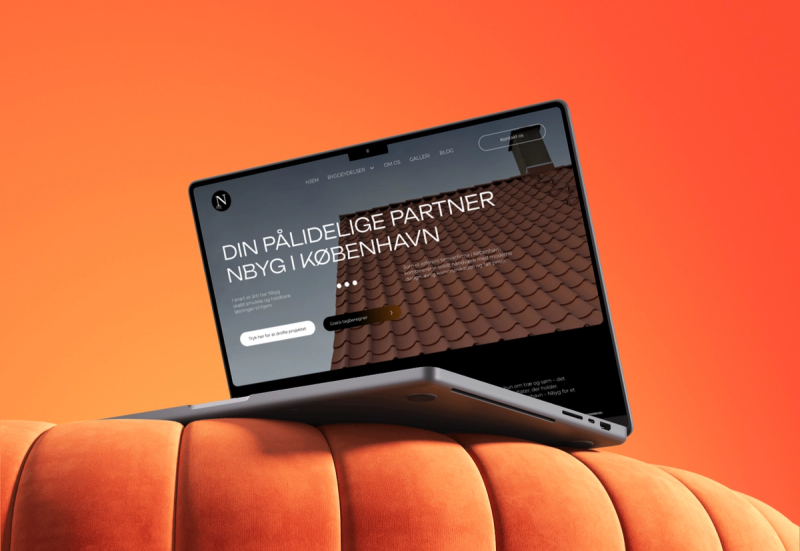
The company works in two locations — Copenhagen and Bornholm. Their old 2018 WordPress site with five paid plugins brought 3 enquiries a month. We built a new site: clear service structure, separated locations, fast loading, an easy CMS. A year on — 300+ enquiries, 302,000 Google impressions, visits up over 1.6× in six months. In the owner's words: it was 3 enquiries a month, now it's 24. Full breakdown — in the NBYG case study.
Where not to cut costs
- Photos of real projects — stock construction photos kill trust instantly; a photoshoot isn't in the website price, but phone photos of your own sites beat stock
- A page per service — those are your entry points from search
- Mobile speed — clients open your site from a phone, often standing on site
- Local SEO — without it, people only find you by your company name