
Why this matters
A web project contract isn't a letter of intent. It's the legal document you'll point to if something goes wrong. And "something" goes wrong in 40% of projects by our count — late, off-spec, off-quality. When it does, the business owner needs in writing: what was promised, by when, and what happens if it isn't delivered.
Of 30 competitor contracts we've reviewed over 3 years, 24 of 30 had at least one of three critical gaps: vague IP transfer, no rebate clause, or "scope under request" (scope to be determined later).
Here's how to avoid that.
Item 1: Fixed price in the agreed currency
❌ Bad: "Approximate cost £3,500-£5,000"
✅ Good: "Total fee is 3,500 USD, fixed, with no additional charges except those listed in Appendix 1"
If the contract says "approximate," "around," "depending on" — that's not a price. It's marketing. You have no legal basis to say "wait, we agreed on £3,500" when the studio invoices £4,800.
Pin down the currency. If the contract is in UAH and the site costs £3,500 — write in the exchange rate as of the signing date or until payment. Otherwise a 2-month FX shift becomes an unpleasant surprise for both sides.
Item 2: Fixed deadline with a rebate clause
❌ Bad: "Approximate timeline — 6 weeks"
✅ Good: "Delivery in 6 weeks from contract signing. If the deadline is missed through the studio's fault, the studio pays a 30% rebate from the total project value."
The rebate clause isn't decoration. It's the only mechanism that holds the studio to its deadline. Without it, the deadline is a guideline, not a commitment.
Market standard for a rebate is 10-30%. Ours is 30% because we really don't want to pay it. Over 3 years we've paid it twice — both times we wired 30% to the client without being asked.
⚠️ Fine print: make sure the rebate applies only to delays caused by the studio's fault. If you as the client sit on content for 3 weeks and miss a deadline — that's your delay, not theirs.
Item 3: Code and design IP transfer — from the first commit
❌ Bad: "All rights to the created code transfer to the Client after full payment"
✅ Good: "The studio commits to your GitHub repository from the first commit. All intellectual property rights belong to the Client from the moment of creation."
This is the most common trap in contracts from smaller studios and freelancers. "After full payment" looks innocent but creates a legal situation where:
- If you withhold the final payment (say, due to a quality dispute), the code isn't legally yours
- You can't hire another contractor to finish the project
- The studio can reuse your code for another client (this actually happens)
The right wording: code in your GitHub from the first commit. We do this with every client — push to your repo from day one. Everything we write is yours.
Item 4: Concrete scope — itemized
❌ Bad: "Web development, including design, frontend, and engineering"
✅ Good: "Website development in the following scope:
- 8 pages (listed in Appendix 2)
- Responsive build for 3 screen sizes
- Integration with 2 systems: Helsi and AmoCRM
- 1 lead form with email notification
- Lighthouse Performance ≥ 90, SEO ≥ 95
- Sanity CMS for self-editing"
If scope isn't written down — it gets discovered "along the way." In practice that means:
- Every clarification of yours is "an additional request"
- Every "additional request" is a separate fee or a contract amendment
- 2 months in, you're paying double for not the site you wanted
A good contract has Appendix 1: Scope on 1-2 pages with concrete page lists, integrations, features, and quality metrics. Anything not in it is a separate fee, also priced upfront.
Item 5: Revision rounds
❌ Bad: "The studio makes revisions until the Client approves the result"
✅ Good: "The studio provides 2 full revision rounds on design and 2 on frontend after staging URL handover. Each additional round is billed at £40/hour."
Without a revision limit you face risk from both sides:
- The studio tries to wrap up faster, ignoring small concerns → you're unhappy with quality
- Or revisions go "forever" and the deadline blows because the project gets sent back 5 times
2 rounds is standard. Round 1: you give all your feedback in one list, the studio fixes it. Round 2: you give last small notes. More than that — separate billing.
We use exactly this model — details on Process.
Item 6: Who writes the content — and at whose cost
❌ Bad: "Client provides content"
✅ Good: "Client provides text content for all pages before the development phase. If content is not provided, the studio may offer copywriting at the standard rate of £200/page. The rate is documented in Appendix 3."
This is the most common source of conflicts and project stalls. The owner orders a site, not understanding that the text on it has to be written. The studio assumes the client will deliver. The client assumes the studio will write.
3 weeks in: the project stalls. Studio waits for content. Client didn't know they had to write it, or doesn't have the bandwidth.
Right: write it into the contract — who's writing, at whose cost. If you want the studio to write — that's a separate line in the quote.
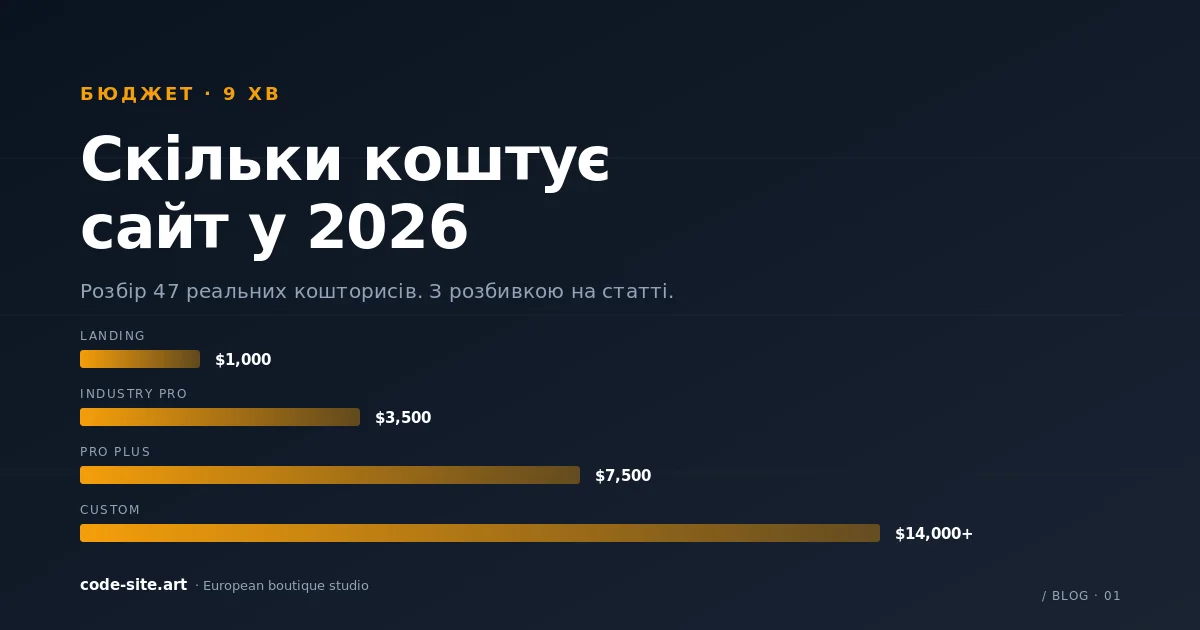
Our base Industry Pro package includes copywriting for the homepage and 5 standard pages (about, services, contact, etc.). If you need more — £200/page.
Item 7: Post-launch support
❌ Bad: "Warranty obligations of the studio remain in force for 30 days"
✅ Good: "The studio provides 1 year of warranty support starting from the launch date. Warranty includes: bug fixes, dependency updates, advisory. Response time: 4 business hours during studio business hours. Warranty does NOT include: new feature development, design changes, content rework."
30-day warranty is an anti-standard. Real post-launch issues often surface 2-3 months in: when clients actively use the site and find rare bugs, or when dependencies update and something breaks.
A good warranty is 1 year. Not "free forever," but coverage for typical post-launch problems.
⚠️ Specify what's in the warranty. Bug fixes — yes. New features — no (otherwise a year of warranty equals a free new project). We list this explicitly in our contract.
Bonus: Who's on the studio side
Doesn't directly appear in the contract, but you can ask for Appendix 4: Project team. It should list:
- Tech lead and designer names, with their LinkedIn / GitHub profiles
- Email and WhatsApp for direct contact
This lowers the risk of "the manager went silent for 2 weeks because they quit." If you see names and profiles — you know who you're dealing with.
Red flags: when to walk
5 phrases in a contract that should make you nervous:
- "The studio commits to best efforts..." — that's intention, not obligation. Permission to underperform.
- "Timelines are approximate..." — without a rebate, there are no timelines.
- "Handover happens orally..." — accept in writing, with a signed handover protocol.
- "100% upfront..." — standard is 50/50. More than that — either you have 5+ years of trust with the studio, or you're risking everything.
- "Early termination requires the Client to pay 100%..." — that makes you a hostage. Standard is staged payment for work already completed.
We've seen all of these in freelancer contracts. Details in vs Freelancers.
Who reviews the contract on your side
Ideal — a lawyer. Realistic — self-review with this checklist + Google + 30 minutes of focus.
If the project costs more than £5,000 — it's worth paying a lawyer £50-£100 for a review. The cheapest insurance policy in IT.