


Everyone in real estate marketing is suddenly talking about “AI SEO”, and almost nobody shows numbers. So here are ours. We run Domlivo, a multilingual property platform in a market where buyers are mostly foreign — which means they research hard before they fly in. Increasingly, that research happens inside ChatGPT. Our job was to be the site it quotes.
The numbers first (all dated, all sourced)
| Metric | Value | Source, date |
|---|---|---|
| Leads with chatgpt.com referrer | 28% of CRM leads | Sanity CRM, 06.11.2026 |
| “AI Assistant” channel | #2 channel: 256 sessions, 32% of total (Direct 302, AI 256, Organic 170) | GA4 traffic acquisition, 28 days, 06.11.2026 |
| AI channel conversion | 21 of 55 key events = 38% — the best of any channel | GA4, 06.11.2026 |
| AI answers citing the site | 73, +54 in a month | Ahrefs, 05.11.2026 |
| Monthly audience | ~5,900 unique visitors, zero paid traffic ever | Microsoft Clarity, 06.11.2026 (bot sessions filtered) |
| Google clicks | 554 per 28 days — ×4 in six weeks | GSC, 07.11.2026 |
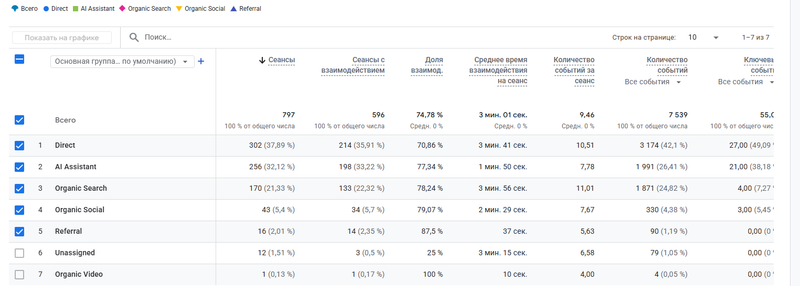
Context that matters: the site had its first Google impressions in early August 2026. These are month-three numbers, built from a standing start, and the AI channel outconverts every other channel the site has.
Why ChatGPT cites this site and not the competitors
When an LLM answers “can a foreigner buy property in Albania?” or “what does ownership verification cost?”, it looks for sources it can trust mechanically: concrete claims, attributed to primary documents, on pages it's allowed to read. Most real-estate content fails all three tests — unsourced claims, recycled myths, and crawlers blocked. We built for the opposite:
- A knowledge base where every number is a quoted fact. 99 articles built on 656 individual facts, each carrying a word-for-word quote from one of 558 primary sources — laws, government decisions, customs tariffs, the statistics institute. When competitors repeat a myth, we publish the refutation with the document. That's the content LLMs select when they need something defensible.
- Our own data nobody else has. A monthly price index across 7 cities with frozen snapshots and open CSV/JSON downloads. Original, dated, machine-readable data is citation bait for both AI answers and journalists.
- Open doors for AI crawlers. llms.txt published; GPTBot, ClaudeBot and peers explicitly allowed; full schema.org markup (RealEstateListing, FAQPage, Organization); fast server-rendered pages. Access doesn't create citations — it's the precondition for them.
- Answer-shaped pages. FAQ blocks with dated, self-contained answers; calculators and checkers (purchase costs, residency routes, legal checks) whose outputs are concrete enough to quote.
- Eight languages, honestly localised. Hand-written translations with per-language URLs — so the site is quotable in the language the buyer asked in.
Note what's NOT on the list: no “AI optimization” tools, no prompt tricks, no content spinning. The mechanism is boringly causal — be the most verifiable source in the niche, be readable by machines, and the machines quote you.
The playbook, in the order we'd repeat it
- Pick the questions buyers actually ask an assistant (visa rules, taxes, process, costs — not “best agency”) and answer each on its own page.
- Source every number to a primary document with the quote visible. Refuse to publish what you can't verify — the restraint is itself the differentiator.
- Publish data only you have: your transaction stats, your price observations, dated and downloadable.
- Open the site technically: allow AI crawlers in robots, add llms.txt, ship schema markup, keep pages server-rendered and fast.
- Track it like a channel: referrer-split your CRM leads, build a GA4 channel group for AI referrers, watch Ahrefs' AI-answer mentions.
And the step most teams skip: wire the leads to a CRM with sources, or you'll never know any of this is happening. 28% from ChatGPT is only a number because every enquiry lands in the CRM with its referrer attached.
What we can't tell you (yet)
- Whether these percentages transfer to your market — AI-assisted research is strongest where buyers are remote and stakes are high (international, investment, relocation). A purely local rental audience may behave differently.
- Perplexity and Google AI Overviews: we have a measurement method but no numbers fresh enough to publish — so we won't.
- How durable the channel is. It's been growing monthly in our data; that's an observation, not a guarantee.
FAQ
Related: why this playbook needs the right foundations — real estate website templates vs custom, honestly compared, and the design walkthrough of the same platform, screenshots included.
To get this machine built for your agency, start at the estate agent website design & development service — the playbook above ships with the Domlivo-level tier.