


“Real estate website template” is one of the most-searched phrases in this niche, and the marketplaces that rank for it will happily sell you a handsome theme for $17–$79. This is not an article telling you templates are evil. It's an attempt to answer the question the marketplaces never do: what exactly does the cheap option not buy you — so you can decide if you need it.
What a template actually is
A real estate theme is a set of page designs: a homepage with a search bar, listing cards, an agent profile, a contact form. On WordPress or a site builder it gets you something presentable within days, and for a predictable, low price. What it standardises is precisely the thing search engines use to choose between sites: structure. Your copy of the theme has the same URL patterns, the same heading skeleton, the same page weight (usually heavy — themes ship every feature every buyer might want), and the same listing-page markup as hundreds of other agencies.
When a template is the right call
- You're a solo agent or a new office and your deals come from referrals, social media and the portals — the website is a business card that confirms you're real.
- You hold a handful of exclusive listings at a time; buyers meet your stock on Rightmove, Zillow-class portals or Facebook anyway.
- The budget is a few hundred, not a few thousand — in that bracket a clean template beats a cheap custom job every time.
- You need it live this month.
In this situation, buy the template, keep the photos professional, and spend the difference on listings and ads. Honestly.
Where templates quietly cost you leads
- Search structure. Organic real-estate traffic lands on listing and area pages, not homepages. That demands every listing as its own indexable page with clean URLs, structured data (RealEstateListing schema), unique titles and internal links by city and district. Themes render listings; they rarely architect them for search — and on a shared theme your structure is identical to every other buyer's.
- Speed. Property pages are photo-heavy; themes are JavaScript-heavy. The combination routinely lands in the orange-to-red Core Web Vitals zone, and both rankings and impatient buyers pay for it.
- Languages. If your buyers come from abroad — the normal case for coastal and investment markets — you need real localisation: translated pages with per-language URLs and hreflang, not a Google-Translate widget. Multilingual plugins on templates are where this dream usually dies.
- Sameness. A buyer who has seen three agency sites this hour doesn't remember the fourth copy of the same theme. Nothing about a template says why you.
- Ownership and drift. Theme licences, plugin subscriptions, updates that break the design — the “cheap” option accumulates a monthly cost and a maintenance dependency.
The comparison, honestly
| Template | Custom platform | |
|---|---|---|
| Time to launch | days | a week to a few weeks |
| Upfront cost | $17–79 theme + setup | from a few thousand |
| Listing pages built for search | rarely — renderer, not architecture | the whole point: every listing and every city×type combination an indexable page |
| Speed on photo-heavy pages | usually poor without surgery | engineered in (image pipelines, static rendering) |
| Real multilingual | plugin lottery | per-language URLs, hreflang, hand-written translations |
| Looks like | every other buyer of the theme | your brand |
| Who it fits | solo agent, referral-driven, few listings | agency that wants Google and AI search as a lead channel |
What the custom route looks like when it works
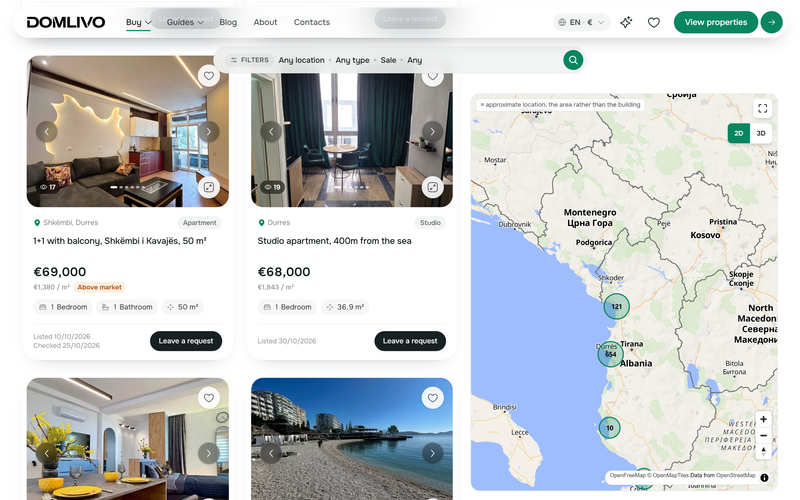
We can show rather than argue, because we run our own property platform: Domlivo, a multilingual real-estate site we built and operate ourselves. It's three months old in the index and does ~5,900 unique visitors a month with zero advertising — every listing is its own page in 8 languages, every city-and-type combination is an indexable catalogue page, and 28% of its CRM leads arrive from ChatGPT, which cites the site's knowledge base. None of that is achievable by installing a theme — not because themes are bad, but because those results come from the architecture layer themes standardise away.
That's the test to run on your own plans: if the website's job is to generate demand rather than confirm your existence, the money belongs in structure — listing pages, speed, languages, data — and that's a build, not a skin. The middle path also exists: start on a template now, and move to a platform when the maths of organic leads justifies it. Just know that the move is a migration project, not a switch.
FAQ
Related: the measured side of the same argument — how our platform gets 28% of its leads from ChatGPT, and the full design walkthrough with screenshots.
If you've read this far and want the decision made with you rather than by a marketplace: our estate agent website design and development page lays out both routes with one-off prices — engine template from €1,500, custom from €2,500.